Categories
Christmas musical culture repetition Rhymetime

The sound of Christmas

I’m not religious. I don’t believe in God, despite a churchgoing childhood. Though I lack a Christian faith now, I do have a passion for the hymns and carols that I heard each week. Sunday School ended in time for us to file quietly into pews at the front of the church for the last ten minutes of the service when the congregation and choir sang hymns. Children soak up experiences and learn without trying, and those tunes and words sung week after week, and year after year, entered my brain and my heart, never to leave.

School concerts, assemblies and nativities added other songs to my Christmas repertoire and just hearing Winter Wonderland and White Christmas ignites a Pavlovian response in me now, giving me the urge to decorate a tree and eat mince pies. Since then, I have picked up lots of new carols and seasonal songs, learnt with choirs and groups of singers, or even from the television. Admit it, don’t we all get that festive feeling when we hear Jingle Bells or young Aled singing ‘we’re walking in the air’? Whether you are a believer or not, it’s hard to resist the pull of Christmas music.

Now it’s our turn to introduce these old favourites to our children. Each December, roles are reversed as parents lustily sing these songs to slightly nonplussed children . We’re introducing them to the sound of Christmas, knowing that very probably they too will sing and love these songs  for years and years.

At the risk of making a shameless plug, don’t forget that if you’d like to hear carols and other winter songs, do consider buying my CD, Winter at Home:Chansons d’hiver, recorded with Les Petits Zouzous.

Categories
musical culture Rhymetime

Getting it wrong

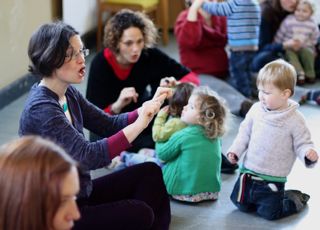
imageSometimes I notice that we are not singing the same words, such as in Wind the Bobbin up. There are even certain songs where we sing slightly different tunes. If Rhymetime were a performance, this would be a disaster. But it’s not. I love the way we all have learnt our own versions, from our parents or sometimes from other English-speaking countries, but that we can still sing them together, the disparity meaning less than the experience of singing in community.

I suppose it’s like a patchwork quilt, or rag rug. Way back in the summer holidays, when the sun was warm and the days were long, I took up a new project. Using the instructions on this video, I cut up old duvets and pieces of fabric bought for long-forgotten crafts, and spent hours pulling and tugging the material into a rug. It’s made of odds and ends of material. Some I bought at a charity shop. Others hold memories. The deep orange section is made of a duvet cover my mother-in-law bought me when Graham and I first got a flat together. The pale blue is a curtain I used as a bedspread when at University. The green section was a cover used by my daughter when she first slept in a proper bed, with only a duvet rather than cot bars to keep her from tumbling to the floor at night. It became threadbare and torn several years ago but I didn’t want to throw it away.

Now, when I see my children lying on it while they read, I see all those memories woven together. And when you sing ‘hokey pokey’ as I sing ‘hokey cokey’, I hear your childhood songs woven together with mine. Vive la difference!

Categories
Joining in Rhymetime

What’s your name?

What's your name?‘When you first sang Ben’s name in the hello song,’ Joanna confided,  ‘I thought I was going to cry!’

Whenever the group is small enough, we sing hello around the circle, greeting each child and baby by name. We’re noticing them, accepting them, and by naming them we are making them part of the group.

I don’t think Joanna’s experience is uncommon. It’s powerful to hear our baby being noticed and to hear aloud the name we have chosen after hours of discussion. Sometimes it’s also the first time that our child is the participant of a group, rather than us, the adult.

I’m only human, and do sometimes forget names, but I try really hard to remember because I know it makes a difference. We all deserve to be named.

Categories
Joining in musical culture Rhymetime

Donkey voices welcome

Join in!

Rhymetime is an activity you do together. Each week your voice and your child’s voice join the greater sound that we make as a group, whether you are singing, laughing, blowing your nose or yawning. But some people feel very self-conscious about their singing and they tell me that they really do have a ‘bad voice’, and that their attempts at karaoke have always sounded like a donkey in pain.

My answer? Do it anyway. There’s a place for donkeys’ voices alongside those of angels and mortals! Most importantly, just doing it can help improve your voice especially when you are surrounded by other people all singing the tune. Singing out of tune is only extremely rarely caused by a physiological problem (if you are human, you have all the vocal chords you need) and can be because you are too nervous to listen and really hear the note. Have a cuddle with your little one, let yourself absorb the tune, and you find that slowly your singing will improve.

Don’t forget, too, that at Rhymetime everyone is so focussed on their child that it’s unlikely that they’ll care how you sound. They’re negotiating peace treaties with the child next to them, avoiding over-enthusiastic bouncing and making sure no-one runs out of the door, not judging The Voice.

After all, if your child could articulate it, they would tell you that they’re not bothered by my voice, or anyone else’s in the group, but that they want YOU to sing. They can, and do, recognise and prefer their parents’ voices over anyone else’s. So they really don’t care how you sound, they just want you to sing.

Sing in the shower. Sing when you’re emptying the dishwasher. Sing when you’re wiping poo off bottoms. Just sing!

Categories
musical culture repetition Rhymetime

What’s Rhymetime? A musical comfort blanket.

Sharing songs Parents often come to Rhymetime saying that they need to learn new songs, and new verses, but actually I think we all have a memory bank of songs in our brains, tucked away, ready to be revitalised. Those songs we learned as children, with our parents or at school, are usually bursting to get out. Constant repetition of Old MacDonald is wearing, I give you that, but when we sing the tunes that our mothers and fathers sang to us, even if we don’t remember it consciously, we sink into the feeling of being safe, as if we are being wrapped in a musical comfort blanket.

By coming to Rhymetime and singing at home we are rebuilding this musical culture, reappropriating old songs, drawing in the new, and weaving a new blanket for our own children.  As our families grow, these songs, sung together, are musical rituals that bond us. The simple tunes become common currency to smooth our course through the day. We can sing them with different words (“This is the way we zip our coat”), or bellow them to distract a hungry child as we tramp through East Street. These songs become part of our lives, to sing again and again and again and again.

Have a good week!

Categories
musical culture repetition Rhymetime

Again? Again!

repetition“Twinkle, please!”

If I don’t sing Twinkle, twinkle little star at Rhymetime, someone small always comes up to me at the end and asks me to put that right. These children know that repetition is good, and we adults sometimes forget this.

Coming together and singing the same songs, week after week (and again at home) makes these songs part of us all. When we sing the songs we know, we feel safe and loved, and it gives our little ones a chance to shine. When you are very small, predictability is a good thing. When you hear You are my Sunshine you can go off and get your coat, wave goodbye and put your money in the pot. You know what is happening, and you are safe, so you can relax and enjoy yourself.

Of course, with each rendition of Wind the bobbin up our child also learns a little more: first the tune, then the actions and words. I get such a thrill from watching the children master Heads, shoulders, knees and toes, first slowly, a little behind, and then faster and faster, singing as they go. Oh, the sheer pleasure of accomplishing this new skill!

Repetition is a brilliant way to practise speech patterns too. When I lived in Italy as a student, I would trudge the streets of Siena mumbling to myself, mimicking the exclamations and conversational gambits of the people around me in an attempt to make my accent less English. This did, of course, make me appear somewhat eccentric (has anything changed?!) but practising these intonations, or the music of the language, gave me confidence when it came to speaking Italian.  Singing is a far easier way of practising. In fact some children can’t talk well enough to communicate but can sing a song clearly. They’ve made the first step, and singing it with you again and again is the best practice there is.

So we sing these songs week after week to create a safe, predictable place where we can master the songs, singing them again and again. And if I slip in a new tune here and there, we can cope with that.